The Road to Emmaus and “the Third Day”
The journey of the two disciples to Emmaus is described only in the Gospel of Luke (Luke 24:13–35) and is also briefly mentioned in the Gospel of Mark (Mark 16:12–13). As is evident from the preceding chapters, the New Testament (NT) -both in the original ancient Greek text and in many Bible translations - states that Jesus did not rise “on the first day of the week” (as modern Bibles report), but “on a Sabbath,” or more precisely, “early on the first Sabbath” (Mk 16:9). Nevertheless, some theologians attempt to misuse the story of the disciples on the road to Emmaus to turn the biblical Sabbath into a pagan Sunday.
On the day of Jesus’ resurrection, the disciples went to Emmaus
Luke 24:1 ff. describes what happened on the day the Lord Jesus Christ rose from the dead. He appeared to the women, but the apostles (including Peter) did not believe them. The account of the disciples on the road to Emmaus begins in the Gospel of Luke with the following words:
“That very day ytwo of them were going to a village named Emmaus” (Lk 24:13).
The two disciples were leaving Jerusalem for Emmaus when Jesus appeared to them along the way. They told him what had happened in Jerusalem and:
“...and how our chief priests and drulers delivered him up to be condemned to death, and crucified him. 21 But we had hoped that he was the one to redeem Israel. Yes, and besides all this, it is now the third day since these things happened” (Lk 24:20-21).
This clearly proves that this is the same “third day” to which Jesus referred when he repeatedly declared that he would rise “on the third day.” The following expressions are used in the New Testament (NT):
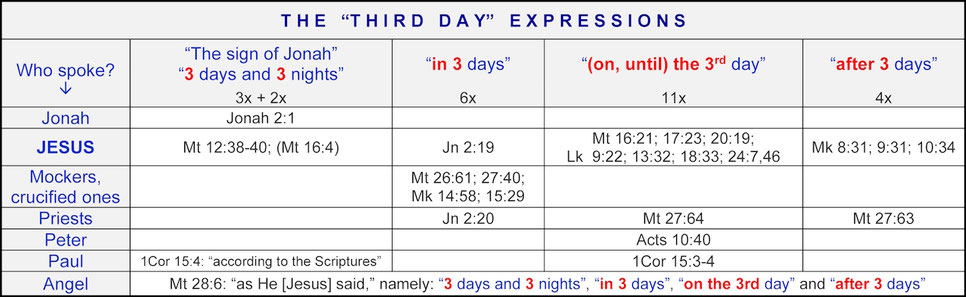
What does this mean in practice? In God’s calendar, biblical calendar days (see “Day”) always begin after sunset and end after sunset. Roman and Catholic calendar days, on the other hand, always begin and end at midnight (in the deepest darkness). In both calendars, a distinction must also always be made between calendar days and “light days” - that is, the part of the calendar day when daylight prevails.
It is important to note that the Gospel writers always referred to the biblical day. Therefore, we must count the days as God intended. The 14th of Nisan was the day Jesus was crucified; He died at 3:00 p.m. and was laid in the tomb no later than between 4:30 and 5:00 p.m. It is the first light day in the count of the “3 days and 3 nights,” for it is “the first light day” that Jesus was in the tomb, where He lay in the rock-hewn tomb for at least an hour on that day, since all those involved had to be in their homes before the start of the High Sabbath (15th of Nisan) to prepare for the first day of the feast (Passover, 15th Nisan) of the year, the first day of the seven-day Feast of Unleavened Bread.
If Jesus had risen as early as the 14th of Nisan, no one would say that He rose “after one day,” but rather “on the same day.” Thus, the following day is
“the first day” after Jesus’ crucifixion (†) and burial. This is followed by “the second day” and finally “the third day,” which Jesus and the
disciples on the road to Emmaus mentioned. This “third day” is a calendar day (Nisan 17) but includes the “fourth light day,” during which Jesus would have been in the tomb. It
is therefore clear that Jesus rose from the dead in the first half of “the third calendar day” (at night), for only in this way could he fulfill the sign of the Messiah (3 days and 3 nights).
The following illustration shows how the calculation is done. Note in particular the green text regarding “the third day,” for this was not only “the third day”
after Jesus’ crucifixion (†) and burial, but also “the third day” of the seven-day Feast of Unleavened Bread.
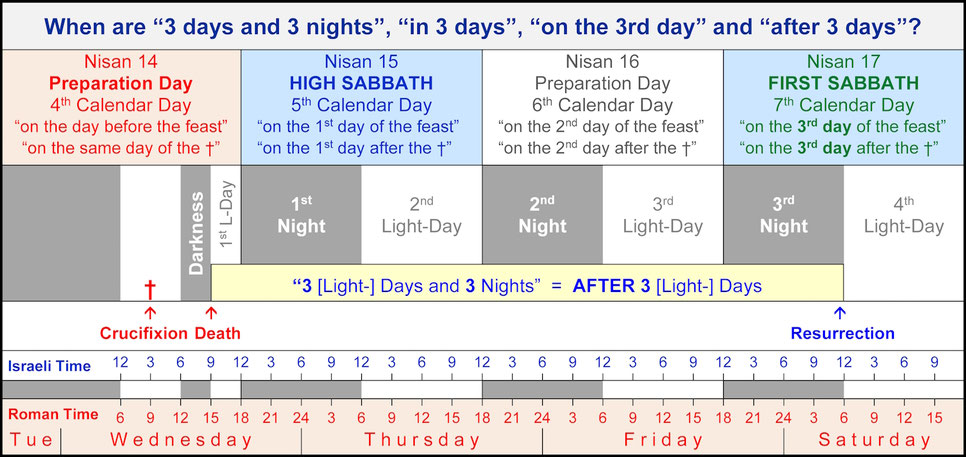
The 14th of Nisan fell on a Wednesday, and the “first Sabbath” on the 17th of Nisan
Here’s a valid question: How can we know today that the 14th of Nisan in the year of Jesus’ crucifixion fell on a Wednesday? This question is very easy to answer, because the sign of the Messiah is “three days and three nights,” and the four evangelists (the four eyewitnesses) describe seven (7) times from 4 different perspectives that Jesus rose on the morning of a Sabbath. So if we count back three days, we arrive at a Wednesday. This is nothing unusual, for in the biblical calendar - and especially in the Jewish calendar - the 14th of Nisan falls on a Wednesday about every three years, but rarely on a Friday. This was particularly evident in the years 2020 and 2023, as in those years both calendars aligned such that Passover fell on the same days. In this way, we can see in both calendars what the sequence of days was at the time of the Exodus from Egypt and at the time of the crucifixion.
Matthew describes in detail the transition from night to day on a Sabbath morning (Mt 28:1), while Mark, Luke, and John speak of “the one/first of the Sabbaths” (Mk 16:2; Lk 24:1; Jn 20:1). This refers to one very special Sabbath, namely the small weekly Sabbath that lies between the two High annual Sabbaths (15th and 21st of Nisan) of the Passover festival. This is also the “first of the seven Sabbaths,” that is, the “first Sabbath” in a series of exactly seven weekly Sabbaths (always Saturday) that must be counted each year between Passover (15th of Nisan) and Pentecost (50th day) and are indicated with a Gregorian date in every biblical and Jewish calendar. Mark makes it very easy for us, for he states literally that Jesus rose “early on the first Sabbath” (Mk 16:9). John goes a step further and writes that Jesus appeared to the disciples “on the evening of that same Sabbath” (as Martin Luther translated Jn 20:19), when the disciples were gathered in the house on that very Sabbath day.
And here we see once again the connection to the disciples on the road to Emmaus, for first, Luke 24:13 refers to “that same day” on which the Lord rose from the dead; second, it is reported that after they had spoken with the risen Jesus, they…:
“And they rose that same hour and returned to Jerusalem. And they found the eleven and those who were with them gathered together, 34 saying, “The Lord has risen indeed, and has appeared to Simon!” 35 Then they told what had happened on the road, and how he was known to them in the breaking of the bread” (Lk 24:33-35).
John also emphasizes that the 14th of Nisan was the day of preparation before a major Sabbath, which in God’s calendar can fall on any day of the week from year to year. It was not the day of preparation before a small weekly Sabbath, for Mark and Luke report that the women prepared the spices both after and before the Sabbath, which is not a contradiction but proves that the women prepared the spices after the High Sabbath and before the small Sabbath. (See the chapter on the Intermediate Day).
There is yet another very important piece of evidence that Jesus was crucified on a Wednesday, for the Israelites know to this day that at the time of the Exodus, the 14th of Nisan fell on a Wednesday and the “first Sabbath” on the 17th of Nisan. That is why, in remembrance, they call every weekly Sabbath (always Saturday) before Passover “Shabbat ha-Gadol” (the Great Sabbath), because they know that in the year of the Exodus, the 10th of Nisan fell on a Sabbath and thus the 14th of Nisan fell on a Wednesday. Only in this way could Jesus fully fulfill the law. He died:
- on the exact same calendar day (Nisan 14)
- on the exact same day of the week (Wednesday)
- He died at exactly the same hour (3:00 p.m.) that the FIRST Passover Lamb was
slaughtered and shed its blood.
Only in this way could Jesus become the LAST Passover Lamb, thereby rendering the continued slaughter of animals unnecessary
- or rather: thereby fulfilling the law.
The Disciples on the Road to Emmaus did not go on Easter Monday
Catholics, however, celebrate the disciples’ journey to Emmaus on Easter Monday, the day after the Easter Vigil. For this reason, many Christians believe the rumor that Jesus appeared to the disciples on the way to Emmaus on the weekday following His resurrection. This is completely false, as Luke demonstrates by referring to “that same day” (Luke 24:13). Google AI also confirms this in its response to the question: “When did Jesus appear to the disciples on the road to Emmaus—was it on the day of the Resurrection or on the following weekday?” The clear answer is:
“Jesus appeared to the two disciples on the road to Emmaus on the day of the Resurrection. According to the Gospel of Luke, this encounter occurred "that very day" (...), shortly after the women had discovered the empty tomb.”
The Gospel of Mark is a brief summary of Jesus’ life. The individual events are described in greater detail in the other Gospels. In 16:9–14, Mark describes to whom the Lord appeared after he had risen “early on the first Sabbath” (Mk 16:9). The same chapter describes how Jesus first appeared to Mary “on the one/first of the Sabbaths” (Mk 16:2) just as the sun was rising. But the disciples did not believe her. Then Mark describes how Jesus appeared to two brothers while they were on their way—this refers to the two disciples on the road to Emmaus, which is described in detail by the evangelist Luke. But the disciples did not believe them either. Then Mark writes:
Mk 16:14: “Afterward he appeared to the eleven themselves as they were reclining at table, and he rebuked them for their unbelief and hardness of heart.”
When were the disciples sitting at the table? This passage refers to the Lord’s appearance “on the evening of that same Sabbath,” when the disciples were gathered together, as Martin Luther translated John 20:19. Anyone can understand this passage; it refers to the “evening of that same Sabbath” and not “the evening of that same first day of the week” nor “the evening of that same Sunday.” The KJV Bible does not render the ancient Greek text in John 20:19, but rather what theologians want:
John 20:19 (KJV): “Then the same day at evening, being the first day of the week [literally: “when evening came on that same day”, or: “the one of the Sabbath-days”], when the doors were shut where the disciples were assembled for fear of the Jews, came Jesus and stood in the midst, and saith unto them, Peace be unto you.”
Earlier (Mark 16:9), this same Mark clearly stated that the disciples on the road to Emmaus did NOT go into the city on Easter Sunday or Easter Monday or on the “first day of the week,” but “early on the first Sabbath”:
Mk 16,9-14 (ESV): “Now when he rose early on the first day of the week [literally: “early on the first Sabbath”], he appeared first to Mary Magdalene, from whom he had cast out seven demons. 10 She went and told those who had been with him, as they mourned and wept. 11 But when they heard that he was alive and had been seen by her, they would not believe it. 12 After these things he appeared in nanother form to two of them, as they were walking into the country. 13 And they went back and told the rest, but they did not believe them. 14 Afterward he appeared to the eleven themselves as they were reclining at table, and he rebuked them for their qunbelief and hardness of heart, because they had not believed those who saw him after he had risen.”
Luke 24:21 does not specify which day of the week is being referred to
In the account of the disciples on the road to Emmaus, the text generally refers to “the third day,” but this passage alone does not tell us what day of the week it was:
Lk 24:21: “But we had hoped that he was the one to redeem Israel. Yes, and besides all this, it is now the third day since these things happened.”
This verse does not specify when the counting begins—that is, whether it starts at the time of the event or only the following day. It also leaves open whether it refers to a calendar day or a light day. Therefore, this Bible verse should not be taken out of context to justify a dogmatic position.
Nevertheless, we can answer this question definitively and completely based on other passages in the Bible. For in the original ancient Greek text of the New Testament, as well as in numerous reliable Bible translations worldwide, it is not only clearly evident that the disciples on the road to Emmaus went into the city on the day of Jesus’ resurrection, but also that this was a Sabbath or even a Saturday (according to many old Catholic Bibles).
This is described by the four eyewitnesses (the four evangelists), who refer to the day of Jesus’ resurrection and the day the disciples of Emmaus went into the city as “Sabbath” (not “week”) a total of seven times. While Matthew describes the transition from night to day on that one Sabbath morning, Mark, Luke, and John refer to this day as “one of the Sabbaths” or “the first of the Sabbaths” in a series of seven weekly Sabbaths between Passover (15th of Nisan) and Pentecost (50th day), which are counted each year according to God’s calendar. This “one of the Sabbaths” is emphasized because it is a very special Sabbath that occurs only once a year, as it is the “one small weekly Sabbath” between the two High annual Sabbaths (the 15th and 21st of Nisan) of the seven-day Passover festival. It is the intermediate Sabbath. A Passover festival always has 3 Sabbaths within just 7 days, and “the first Sabbath” in the sequence of these seven weekly Sabbaths (Saturdays) leading up to Pentecost is the small weekly Sabbath (always a Saturday) between the two High annual Sabbaths on the 15th and 21st of Nisan, which can fall on any day of the week from year to year (see 2023). That is why Mark states quite clearly that Jesus rose “early on the first Sabbath” (Mk 16:9). It could not be clearer.
However, since most Christians neglect and ignore the Old Testament and refuse to acknowledge God’s biblical calendar, they do not understand this expression and mistakenly think of the “first day of the week,” which cannot be the case, since there are entirely different ancient Greek terms for that (see the chapter “No Sunday”).
The Sabbath Way?
And what about the Sabbath journey? Some theologians use the story of the disciples on the road to Emmaus to try to prove that the day of the resurrection supposedly could not have been a Sabbath, since the distance between Jerusalem and Emmaus would be too far for a Sabbath walk. This is a similar argument to the one claiming that women were not allowed to anoint Jesus on the Sabbath. This is pure nonsense, as is clearly demonstrated in the chapter on the intermediate day (heading: “It Was Not a Sin to Anoint the Dead on the Sabbath”). These two arguments are also frequently used by Adventists, the Church of God, and Jehovah’s Witnesses.
The distance from Jerusalem to Emmaus is given as 60 stadia in the biblical account in the Gospel of Luke (Luke 24:13). This corresponds to approximately 11 to 12 kilometers, or about 7 miles. A stadium (Greek: stadion) is an ancient unit of length that generally corresponds to about 185.25 meters. Originally, it referred to the length of the running track in a sports stadium. Biblical texts usually use the Roman or Greek measure of approximately 185 meters as a basis. One stadium corresponds to 600 Greek feet or 625 Roman feet (Latin: pes, approx. 29.57 to 29.63 cm). In ancient times, 60 stadia corresponded to a walk of about two to three hours. Since the exact location of the biblical Emmaus has not been historically clarified, the distances vary between 7, 11, and more kilometers depending on the identified sites (Al-Qubeiba or Motza (Kolonia)). When the brothers arrived in Emmaus, it was already evening (Luke 24:29). Afterward, they returned to Jerusalem (Luke 24:33).
The Origins of the Sabbath Journey
The Torah itself does not specify an exact number of kilometers that may be traveled on the Sabbath. The Sabbath journey is a purely human invention and an unauthorized addition to the Bible. The rabbis derived the restriction from two key passages: The concept of the Sabbath journey is based, first, on an interpretation of Exodus 16:29: “... Remain each of you in his place; let no one go out of his place on the seventh day,” and second, on the Sabbath commandment in Exodus 20.
The rabbis’ key consideration here was this: In the desert, the Israelites’ camp was square. The Tabernacle (the portable sanctuary) stood in the center. The Israelites had to go there to pray.
The distance: The scholars calculated the distance between the tents at the edge and the Tabernacle to be 2,000 cubits (approx. 900–1,000 meters, approx. 18–20 minutes’ walk). Since this route to
worship was permitted from the farthest points of the Tabernacle, it became the standard for the “Sabbath journey.”
This is a rabbinic interpretation (Halacha) that likely originated in the post-exilic period (after 538 BCE) and was known in the time of Jesus (1st century CE). The final determination of
exactly 2,000 cubits (approx. 900 to 1,000 meters) was established solely through oral tradition, which was later recorded in writing in the Mishnah (Tractate Eruvin) (around 200 CE).
In New Testament times, the “Sabbath journey” was a well-known unit of measurement. In Acts (1:12), the distance from the Mount of Olives to Jerusalem is explicitly described as “a Sabbath journey”:
Acts 1:12: “Then they returned to Jerusalem from the mount called Olivet, which is near Jerusalem, a Sabbath day’s journey away.”
It is important to note that by Jesus’ time, the Tabernacle no longer existed; instead, there was a large temple in Jerusalem with a wide surrounding area. On the Sabbath, people came to the temple on foot from far away; naturally, not all the inhabitants were located within a one-kilometer radius of the temple. The Tabernacle was a camp that the Israelites were not allowed to leave. But we no longer live within the confines of a tabernacle, and so the implications of the Sabbath journey must be defined differently. The Bible does not contain such regulations. While the Israelites were required to rest on the Sabbath, there were always exceptions—for example, when a person’s health or life was at stake, or during times of crisis or war.
The religious leaders of his time had interpreted God’s laws extremely strictly, so that the Sabbath had become a burden for many people. Jesus criticized this on several occasions. The priests had even forbidden the healing of the sick on the Sabbath; YET JESUS OFTEN HEALED MANY SICK PEOPLE ON THE SABBATH: HE DID NOT ACCEPT THE RULES ESTABLISHED BY MEN. That is why the Pharisees and scribes said that Jesus was a sinner and even a man possessed by demons. Just as the prohibition against healing the sick on the Sabbath must be considered, so too must the commandment regarding the Sabbath path. Anyone who reads the entire Bible several times would never conclude that God issued a commandment regarding the Sabbath path. These are human additions to the Bible.
Important: Even if the disciples had traveled a distance on the road to Emmaus that exceeded what the priests had permitted, this would still have nothing to do with the fact that Jesus appeared to these disciples on the very day of the Resurrection. The point here was not at all what is permitted on the Sabbath, but rather that Jesus rose from the dead “on the third day.” That was and is the sensational message that had to be proclaimed to the world, precisely on a Sabbath, while the disciples were on their way.
The strange thing is: Many Christians who observe the Sabbath today would often break it to drive to church or visit family members on the Sabbath if observing the Sabbath were still mandatory and essential to avoid damnation. But most of them don’t think about that. Instead, they set rules that they themselves don’t follow, thereby judging themselves.
We did not write the Bible, and we are not offering a theological interpretation here; rather, we accept the Word of God exactly as it was given to us by God—without omitting anything and without adding anything. The fact that Jesus rose “early on the first Sabbath” (Mk 16:9) is a biblical truth confirmed in many old and new Bible translations. See the list of numerous examples at the end of the text on the Bible passage Mark 16:9.
We must not twist God’s words in the Bible to fit church teachings or redefine the meanings of terms (Sabbath, week, Sunday); this is no trivial matter, but a matter of life and death:
- Psalm 12,6: “The words of the Lord are pure words, like silver refined in a furnace on the ground, purified seven times.”
- Dt 4:2: “You shall not add to the word that I command you, nor take from it, that you may keep the commandments of the Lord your God that I command you.”
- Dt 12:32: “Everything that I command you, you shall be careful to do. pYou shall not add to it or take from it.”
- Prov 30:5-6: “Every word of God proves true; he is a shield to those who take refuge in him. 6 Do not add to his words, lest he rebuke you and you be found a liar.”
- Rev 22:18-19: “I warn everyone who hears the words of the prophecy of this book: if anyone adds to them, God will add to him the plagues described in this book, 19 and if anyone takes away from the words of the book of this prophecy, God will take away his share in the tree of life and in the holy city, which are described in this book.”
- Mt 18,6-7: “but whoever causes one of these little ones who believe in me to sin, it would be better for him to have a great millstone fastened around his neck and to be drowned in the depth of the sea.”
- Gal 1,8-9: “But even if we or an angel from heaven should preach to you a gospel contrary to the one we preached to you, let him be accursed. 9 As we have said before, so now I say again: If anyone is preaching to you a gospel contrary to the one you received, let him be accursed.”
The Bible says: The first and the last Passover lambs died at exactly the same time: on the same calendar day (the 14th of Nisan), on the same day of the week (Wednesday), and at the same hour (3:00 p.m.). Only in this way could Jesus perfectly fulfill the symbolism of the sacrificial Lamb. Through His resurrection after “three days and three nights” (the sign of the Messiah) and “on a Sabbath morning,” Jesus fulfilled the Sabbath commandment and became our eternal Sabbath rest. By grace alone are we called and have received eternal life. Agape love is our hallmark, and the Word of God is our foundation; every word in the Bible has its meaning, and when God mentions the Sabbath seven times in the Resurrection chapter of the New Testament, He does NOT mean seven times Sunday—the weekly holiday of Jesus’ pagan murderers, which the world celebrates today. If God had meant Sunday, he could have chosen from over 25 possible and well-known expressions in Ancient Greek. More on this in the chapter “No Sunday.”
“Prove all things; hold fast that which is good. Abstain from all appearance of evil“
(1Thess 5:21-22)
“Take no part in the unfruitful works of darkness, but instead expose them“
(Epheser 5:11)