The serious errors of James Strong and Biblehub
The website Biblehub.com is frequently used by Christians to view the interlinear text of the Bible. It is very useful for quickly identifying the underlying word in ancient Greek and its meaning. For this purpose, James Strong numbers are used, which define each Hebrew and ancient Greek word with a number. However, both the Strong numbers and Biblehub contain some serious errors, as some verses of the Bible are not translated literally, but according to church dogma, i.e., as theologians wish. One of the huge errors is that the word “Sabbath” is also rendered as “week” and that no distinction is made between cardinal numbers (one, two, three...) and ordinal numbers (first, second, third...). Thus, the day of the resurrection of our Lord Jesus Christ is moved from a Sabbath to the “first day of the week” (Sunday), although many other Bibles (including the Vulgate) have been translated correctly and speak of “a Sabbath” morning. So we are not spreading any special doctrine here, but rather ancient Christian basic knowledge that can be easily and quickly verified. In general, Biblehub is mainly based on the English text of the King James Version (KJV), which is particularly evident in Isaiah 14:12, where it speaks of “Lucifer,” although the Hebrew text refers to the “morning star” (helel, Strong's number H1966).
Some Christians have studied our website, but they have a problem because they quote the definition of individual words from Strong's numbers and Biblehub and use it as proof that the word Sabbath supposedly also means week, which seems to be a fact for them. No, the fact is only that it is defined that way on the website, by James Strong, and in Catholic and some Protestant literature. But that does not mean that it is true and in accordance with God's will. God spoke seven (7) times in the resurrection chapter of the NT about a Sabbath in the singular (σαββατου, sabbatou) and plural (σαββατων, sabbaton); that alone is a fact. God did not use the well-known ancient Greek word for week (εβδομάδα, ebdomada), but spoke of the Sabbath. That is a fact. The translation of the Sabbath as week or Sunday is a brazen manipulation and falsification of the Word of God, which God will not let go unpunished, because it leads God's children to false holidays and seduces them away from the biblical days of assembly with God.
We have contacted the operator of the Biblehub website several times, but have never received a response. Therefore, we have no choice but to publish a counter-statement to warn other Christians. This is not about who is right and who is wrong, but about much more. It is about preserving the pure teachings of Jesus Christ and His gospel. The complete gospel includes not only the fact that he rose from the dead, but also the day of the week on which this happened. This question is extremely important to God. That is why God named this day of the week not just once, but seven (7) times with his name “Sabbath” in the singular (σαββατου) and plural (σαββατων). And this was not only confirmed by one author, but the name of the day of the week on which Jesus rose from the dead was given from four perspectives by four different evangelists, namely Matthew, Mark, Luke, and John.
The Bible is inspired by the Holy Spirit, and every single word was carefully chosen by God. God refers seven (7) times to a Sabbath in connection with the day of the week on which Jesus Christ rose from the dead. He did not choose the terms known in ancient Greek for “week” (εβδομάδα, ebdomada, literally ‘sevenness’) or “Sunday” (ημέρα του ήλιου), nor did he choose the common expressions “after the Sabbath,” “on the first day of the week,” and “on a Sunday,” as is clearly demonstrated in the chapter “No Sunday.”
Not a single word may be stolen from the Bible and replaced with another word. When God speaks of the “Sabbath,” He means the Sabbath and not a 7-day week with a Sabbath, nor Sunday, the holiday of the pagan murderers of Jesus. Biblehub has not published its own translation, but it draws on data sets that reflect the spirit of the times and favor the definition introduced by the KJV and James Strong. We kindly ask the operators of the Biblehub website to correct these errors as soon as possible, because they are not messing with us, but with God and the Word of God (Jesus Christ) personally. The Bible teaches only one gospel and knows no other Sunday gospel, but warns against it (Gal 1:8-9).
What authority has the right to define words?
First of all, we would like to thank the operators of the Biblehub.com website for their efforts and hard work, which enable Christians to study the Word of God more accurately and quickly. However, when such major errors are present, we must not remain cowardly silent, but must point them out so that we do not become complicit in leading other Christians to believe in the wrong day of the week on which Jesus was resurrected. Yes, we deliberately use the word “misled” here, because there cannot be two gospels and two different days of resurrection, from which every Christian can choose whichever they prefer, depending on which Bible translation they use.
We are not spreading any new teachings here, but have already pointed out in detail on our website that there are hundreds of correctly translated Bibles around the world (see Old Bibles). These do not contain the errors of James Strong and Biblehub, but the respective authors distance themselves from them. The Catholic Jerome (translator of the Vulgate), Mentelin (first printed Bible in a national language, 1466), and Martin Luther (1522, 1545) translated correctly and would never accept James Strong's theory. Biblehub may only quote, but it is complicit in spreading false teachings because it does not point out the errors, but continues to publish them without comment, ignores corrections from experts, and does not even respond to them. Only God has the right to define times and days, and the Bible interprets itself and indicates in many other places what a particular word means and what it does not mean. God clearly defined the terms “Sabbath” and “week” at creation and has confirmed them repeatedly.
The Strong numbers and their serious errors
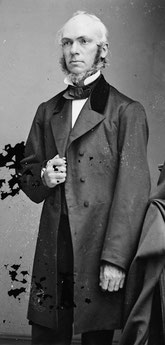
James Strong (1822–1894; Wikipedia) was an American Methodist theologian. His best-known work is “Strong’s Exhaustive Concordance of the Bible”, commonly known as “Strong's Concordance”, which was first published in 1890, and has been reprinted many times since. It contains an index of all words in the King James Version (KJV), with each Hebrew and ancient Greek root word assigned a number.
This resulted in two dictionaries with 8674 Hebrew and 5523 Greek word roots. This allows the reader of a translation (e.g., the King James Version) to quickly check which word appears in the original biblical text. They can also directly compare how the same word is used elsewhere in the Bible. The basic idea is good, but James Strong made crucial mistakes. Many authors and theologians after him, who later adopted this system almost unchanged, spread Strong's error throughout Christianity worldwide.
James Strong's mistake was that he focused too much on the text of the King James Version of 1611, which had been printed some 370 years before him and contains numerous errors (evidence). In order to assign a corresponding number in the source text to most of the words in the King James Bible, he had to make compromises and wrote not only what a Hebrew and Greek word actually meant, but also how it was translated by theologians. Here are a few examples:
The following lines contain quotations from James Strong in red. They show how he translated some ancient Greek words, which means that they reflect his personal opinion, which was also supported by his Methodist church. These are not inspired definitions that come from God, but definitions from theologians and their respective churches. The following Strong numbers from the Greek (G) text are involved:
1. 3957, pascha (Passover)
2. 3391, mia (one)
3. 4413, prótos (first)
4. 4521, sabbaton (Sabbath)
5. Strong's numbers for the words eternity, grave, Hades, soul, hell...
6. Further errors in the creation of Strong's numbers
1. Strong's number 3957, pascha
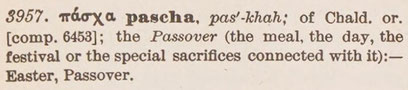
Quote from James Strong with his definition of Strong number 3957, pascha:
“Passover. Of Chaldee origin (compare pecach H6453); the Passover (the meal, the day, the festival or the special sacrifices connected with it): -- Easter, Passover.”
Wrong. Passover never means Easter. This is a catastrophic mistake, an absolute NO GO, which clearly shows that the writers of the King James Version 1611 were not interested from the outset in finding a uniform English equivalent for every Hebrew and Greek word, but rather in interpreting the Bible flexibly and adapting it to their own church teachings. James Strong defined the word correctly, but after the symbol “: –” (or “: --” in Biblehub) he provides additional information about how the word was translated in the KJV. The text after this symbol is therefore NOT the actual meaning or definition of the word in Greek, but shows how others have translated it. James Strong should have pointed out in his text that the KJV made a huge mistake by using the word “Easter.” Thus, he is partly to blame for allowing this misunderstanding to enter Christianity.
When Christians read such a definition in Strong's numbers, it is no wonder that they think that Luke in Acts 12:4 was supposedly referring to the Catholic Easter celebration. James Strong therefore NOT only defines what a Greek word means, but also how it has been translated in some Bibles. Martin Luther had already made this mistake, which can also be found in the King James Version 1611. Readers are thus led to believe that the early Christians allegedly celebrated Easter, which was never the case, because the Bible speaks of the 7-day Passover feast. Instead, it was replaced as Christians wish:
Luther 1545: “Da er ihn nun griff, legte er ihn ins Gefängnis und überantwortete ihn vier Rotten, je von vier Kriegsknechten, ihn zu bewahren, und gedachte, ihn nach Ostern dem Volk vorzustellen [translated: to present him after Easter to the people.”
KJV 1611: “And when he had apprehended him, he put him in prison, and delivered him to four quaternions of soldiers to keep him; intending after Easter to bring him forth to the people.”
This is not a careless mistake that can occasionally occur, but a deliberate manipulation and falsification of the Word of God. The 7-day Passover feast must NEVER be translated as Easter. If God had meant Easter, He would have said so. God spoke of the Passover, and that is how it must be translated. The Passover follows God's biblical and astronomical calendar, whereas Easter follows the non-biblical and non-astronomical calendar of the Pope, who changed God's times and set his new feast days so that they never or only very rarely coincide with biblical feast days. With such false translations, Satan succeeds in diverting Christianity from the calendar that Jesus and the early Christians used. He has succeeded in this, because today only a few Christians know how God sets His feast days. Instead, they follow the Catholic calculations and twist the statements of the Bible to suit them. Even the Catholic Vulgate did not engage in such linguistic adventures; it translated correctly with “pascha.”
Let us note: In the Bible, Passover always means Passover, except after the time of the resurrection, because then, according to theologians, the same word Passover also means Easter. In the same way, the Sabbath is also redefined. The word Sabbath in the singular and plural always means Sabbath or Sabbaths throughout the Bible, except since the resurrection of Jesus. Since then, the Sabbath supposedly also means week or Sunday. No, these are not translations, they are terrible substitutions.
2. Strong's number 3391, mia

Quote from James Strong with his definition of Strong number 3391, mia:
“first, one, other. Irregular feminine of heis 1520; one or first: -- a (certain), + agree, first, one, X othe”
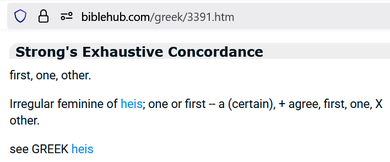
Wrong. The feminine word mia (μια) means one, but not first (prote), because there is another Strong number for that, namely 4431. The writers of the KJV 1611 and James Strong do not differentiate between cardinal numbers (one, two, three...), which denote a number/quantity, and ordinal numbers (first, second, third...), which indicate a position in a sequence.
As the screenshot on the right shows, first is even placed before one, a clear mistake.
The Bible passages in Gen 1:5 (one day) and Rev 9:12 (one woe), where one is often translated as first, give no reason for a replacement instead of a translation (see: one not first).
Just as God said in Matthew 26:17 “on the first [day] of unleavened bread” (τη πρωτη [ημερα] των αζυμων), He could also have said “on the first [day] of the Sabbaths” (τη πρωτη [ημερα] των σαββατων) or “on the first [day] of the week” (την πρωτη [ημερα] της εβδομαδας). The fact is: if God had meant the word first/prote in Mark 16:2, Luke 24:1, John 20:1, and Acts 20:7, He would have said so. However, He only had it written down in Mark 16:9, where it refers to the first Sabbath of the seven weekly Sabbaths until Pentecost. Theologians have invented a new definition of mia (one) because this is the only way they can arrive at the “first day of the week,” thereby distorting the statements of the Bible. Anyone who disagrees and wants to argue should translate “on the one of the Sabbaths” from English into Ancient Greek and will find that the only possible translation is the one found in the New Testament. This cannot mean at the same time “on the first day of the week” or “on a Sunday,” because there are completely different words for this in ancient Greek.
See the chapters: “one, not first” and μια των σαββατων.
3. Strong's number 4413, prótos
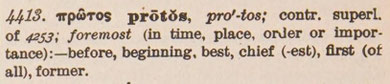
Quote from James Strong with his definition of Strong number 4413, prótos:
“first, beginning, best, chief. Contracted superlative of pro 4253; foremost (in time, place, order or importance): -- before, beginning, best, chief(-est), first (of all), former.”
Right. The KJV and James Strong correctly translate the ordinal number “first” (prote) and do not equate it with the cardinal number “one” (mia). Every language in the world can clearly distinguish between one and first, including Ancient Greek, and God expressed Himself extremely clearly and unambiguously in the New Testament. So we must translate as God wants us to, not as the Pope and theologians want us to.
4. Strong's number 4521, sabbaton
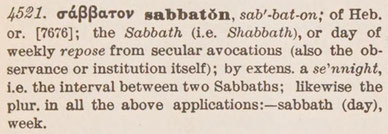
Quote from James Strong with his definition of Strong number 4521, sabbaton:
“Sabbath day. Of Hebrew origin [shabbath 7673 or 7676]; the Sabbath (i.e. Shabbath), or day of weekly repose from secular avocations (also the observance or institution itself); by extension, a se'nnight, i.e. the interval between two Sabbaths; likewise the plural in all the above applications : -- sabbath (day), week.”
Wrong. That is a disastrous definition and a theological lie. In no language in the world does the Sabbath also mean a 7-day week with the Sabbath, least of all in Hebrew. Only in the imagination of Christians did this new, erroneous definition arise in order to piously transform the biblical Sabbath into a pagan Sunday. When the Catholic Vulgate was written by Jerome in 382 AD, Ancient Greek (Koine) was still the colloquial language, and even this Catholic translated correctly and spoke of the women who came to the tomb “on a Sabbath” (una sabbati = on a Sabbath; in the singular genitive).
Very important: Many pastors use the above quote from James Strong to prove that the Sabbath with Strong number 4521 allegedly also means a week, even though there is a separate Greek word (εβδομάδα) for this. However, they overlook the symbols, because the text after the symbol “: –” or “:--” (in Biblehub) does not mean that James Strong defines it that way, but only that it was translated that way in the KJV. This is a big difference. This symbol is explained in detail in the preface to Strong's Concordance (see also Chapter 6). However, many pastors do not know what these symbols mean and quote the text to persuade us that the last and seventh day of the week (Sabbath, day of rest) supposedly also means a 7-day working week with the Sabbath (as the 7th day) at the end. It would be a joke if it weren't so sad. How low has man sunk that he invents such erroneous interpretations just to bring Sunday into the Bible?
The problem is that Strong numbers are also translated into other languages, such as German and Spanish. However, these editions usually do not contain a preface explaining the symbols in “Strong's Concordance”, but merely translate the main text with some new modified symbols. This leads readers to automatically assume that these are word definitions by James Strong. No, the symbol “: –” simply indicates how it was translated in the KJV, but not what a word actually means. Most pastors who quote Strong numbers are unaware of this and make big mistakes in their sermons when they try to defend their Sunday with Strong numbers. Some even claim that there is supposedly no ancient Greek word for “week” because they cannot find it in Strong's numbers. These are terrible false teachings, terrible fake news. Fact is: In the NT, God spoke seven times about the resurrection “on a Sabbath” and zero times about the resurrection “on the first day of the week,” which is why no one can find the corresponding Greek word for week in the NT and therefore also not in Strong’s Greek number list.
The background to the mistranslation: James Strong noted that in his King James Bible of 1611, the Sabbath in both the plural (σαββατων) and singular (σαββατου, Mk 16:9) was translated as “first day of the week”, although earlier English Bibles did not make this mistake (examples). In his definition of the word sabbaton No. 4521, James Strong quoted the errors of the KJV without pointing out that it was mistranslated. He also wrote: “the interval between two Sabbaths; likewise the plural in all the above applications.” This is inaccurate information that helps no one, since the Hebrews defined the week as 7 days, with the Sabbath being the last day of the 7-day week. This never had anything to do with Sunday.

In Hebrew, the Sabbath was never equated with the week, nor was it in other languages. When theologians cannot find the Greek word for week (εβδομάδα) in the list of Strong numbers and therefore believe that the evangelists had to speak of Sabbaths to describe a week, this only shows their lack of knowledge of the Bible. A corresponding Strong's number for the week cannot exist, since James Strong only used the Textus Receptus and the KJV as a basis, but not many other Greek texts (such as the Septuagint or the writings of Josephus Flavius) in which the week is found in its grammatical forms. Of course, all Greeks could speak of a week (εβδομάδα, ebdomada), as could the Jews, because they themselves had already written this down 200 years before the birth of Jesus Christ in the Bible, in the Septuagint, the ancient Greek translation of the Old Testament (see week). Every language has a word for “week,” as James Strong knew, because he himself defined the Hebrew word for “week” (shabuha), which appears in the Old Testament, with the Strong number H7620. Hebrew has always been able to clearly distinguish between the Sabbath and the week. The evidence:
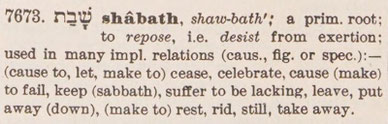
Quote from James Strong with his definition of the Hebrew Strong number H7673, shabbath:
“A primitive root; to repose, i.e. desist from exertion; used in many implied relations (causative, figurative or specific): -- (cause to, let, make to) cease, celebrate, cause (make) to fail, keep (sabbath), suffer to be lacking, leave, put away (down), (make to) rest, rid, still, take away”.
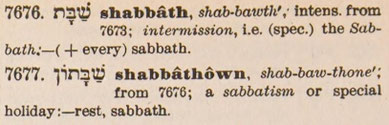
The Hebrew word “Shabbat” means: to cease, to rest, to refrain, to hold back. But the Hebrew word “shabua” (week) means seveness/sevened, i.e., a unit of seven (days). We can clearly see that there was no misleading mixing of words in the Old Testament, since Hebrew has always had its own word for week, namely shabua (Strong's No. H7620):
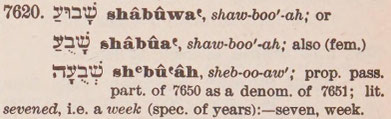
Quote from James Strong with his definition of the Hebrew Strong number H7620, shabua -week:
“shabuwa or shabua; also (feminine) shebueah {sheb-oo-aw'}; properly, passive participle of 7650 [shaba'] as a denominative of 7651 [sheba']; literal, sevened, i.e. a week (specifically, of years): -- seven, week.”
In the Septuagint, which was translated into Greek by the Jews themselves, the corresponding Greek word for week (εβδομάδα, ebdomada) appears in these Bible passages (see list under week), which also means “seveness/sevened” (a unit of 7). The Greek word for week (εβδομάδα) was therefore already included in the Greek Bible 200 years before the birth of Jesus Christ. Everyone knew this word, and the evangelists would have had to use it if they had meant a week (εβδομάδα) and not the Sabbath (σαββατου, σαββατων).
The “Hebraisms” invented by Christians are in reality “Christianisms”
So when theologians speak of so-called “Hebraisms” to replace the Sabbath with the week, this is an obvious lie that can even be proven using the Hebrew Strong numbers (H7620, H7673, H7676). These are not “Hebraisms,” but pure “Christianisms,” i.e., Christian inventions to transform the Hebrew Sabbath into a pagan Sunday. The purpose of these invented “Hebraisms” is to falsify the Word of God in a seemingly pious way. Please fly to Israel yourself and try to convince the Israelites that the Sabbath supposedly also means a week or Sunday (as Walter Bauer defines it), and you will see that you will be thrown out everywhere as a false teacher. Only in Christian circles that place Sunday above everything else will you find agreement with this theory.
Once again, let us be very clear: the Hebrews never equated the Sabbath with the week; we find no evidence of this whatsoever. Instead, this new alleged “definition” appears for the first time in Christian literature (among the catholic church fathers) in order to transform the Sabbath mentioned in the Bible into a pagan Sunday. These people spoke little or no Hebrew and sought excuses to abolish the Sabbath mentioned in the Greek New Testament. Their theories have survived to this day because many Christians want to distance themselves strictly from the Sabbath and are also looking for excuses.
The historical facts are: All Hebrews knew that Hebrew, Ancient Greek, and Latin each had their own names for the week (see definition week). They could always differentiate because they knew that it was not humans, but God Himself who had defined the week and the Sabbath since creation. But theologians who call themselves “Christians” dare to place themselves above God and change God's definitions. This is all so embarrassing, because if the plural ‘Sabbaths’ (σαββατων) is supposed to mean “week,” then it would also have to be “weeks” in the plural, since each week has only one weekly Sabbath. But “on the first day of the weeks” (plural) does not sound as nice as Sunday Christians would like it to. In addition, they also transform the Sabbath (σαββατου, Mk 16,9) in the singular into a 7-day week with the Sabbath. It is unbelievable that so many Christians go along with this and so few defend the pure Word of God.
The manipulations of the authors of the King James Bible, James Strong, the Methodists, Anglicans, Calvinists, Jehovah's Witnesses, Adventists, and Catholics become apparent:
1. Passover always means Passover in the Bible, except after the time of the resurrection, when the same word “Passover” supposedly also means “Easter.”
2. And in the same way, the word “Sabbath” (whether in the plural or singular) is also redefined. Throughout Greek literature, in the Septuagint, and throughout the NT, it always means Sabbath, except on the day of Jesus' resurrection. Then the 100% identical word “Sabbath” (σαββατου, σαββατων) suddenly also means ‘week’ (εβδομάδα) or even “Sunday” (μέρα του ήλιου; μέρα ήλιου), even though there were and still are completely different Greek words for this. This involves the alteration of 9 Bible passages:
Mt 28:1; Mk 16:2; Mk 16:9; Lk 24:1; Jn 20:1, Jn 20:19; Acts 20:7; 1 Cor 16:2; Lk 18:12.
For many Christians, a lie has become the truth because they have heard and read it so often since childhood. You only have to repeat a lie often enough, and it becomes the truth for many people. Many pastors do not listen to arguments and do not care about the extremely large number of correctly translated Bibles. They are afraid of losing their jobs and defend their Sunday with the same arguments as those who wanted to change the Sabbath to Sunday even before the time of Emperor Constantine. They do not even realize that they are preaching a different gospel (Gal 1:8-9). In doing so, they condemn themselves, because the Word of God is the most precious thing we have, and every word of God has its meaning and must not be removed or changed. We are sorry to say this so clearly, but these are demonic definitions, because there is not a single passage in the Bible that would support these crazy teachings.
The fact is: if God had meant the week or Sunday, He would have said so; He had more than 24 options for this in ancient Greek, see the chapter “No Sunday”. However, God spoke seven (7) times about the Sabbath; this is a fact that can be found in all ancient Greek source texts and in many correct translations worldwide. No one has the right to claim that God means Sunday when He speaks of the Sabbath.
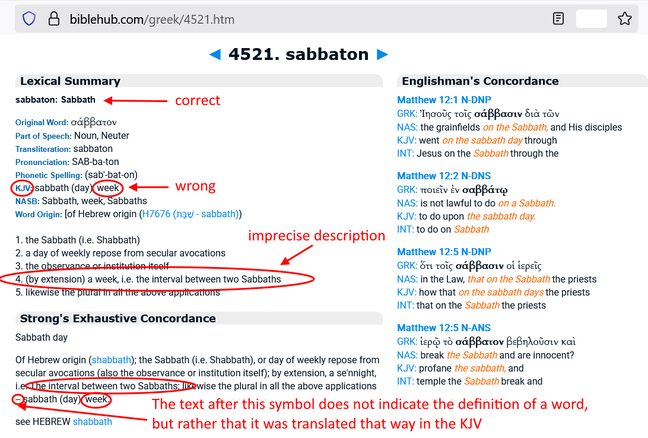
We expressly distance ourselves from the definitions of the KJV, James Strong, and Biblehub, which reinterpret the biblical Passover as “Easter” and the Sabbath as a “week”.
This is not a translation, but a substitution. It is a clear distortion of the Word of God.
Even worse are the definitions that some theologians like to quote in their so-called “specialist literature” from Walter Bauer (“Greek-German Dictionary of the Writings of the New Testament and Other Early Christian Literature”), who even defines the Sabbath (σαββάτου) in the singular not only as a week, but also as Sunday. For us, this is a crime.
We ask all Christians not to believe anyone (including us) blindly. Please examine everything for yourselves every day, as the Christians in Berea did (Acts 17:11). God says: “test everything; hold fast what is good” (1 Thess 5:21) and "... take no part in the unfruitful works of darkness, but instead expose them" (Eph 5:11). Help us to expose the counterfeits in the Word of God and warn other Christians while there is still time. Do not be misled by the erroneous definitions of people who pursue their own goals to support the teachings of their respective churches. Look at how each Greek word is used in other places in the New Testament and in the Septuagint (LXX), and you will know what God means by it, because He (not KJV, not James Strong) chose every ancient Greek word that was to become part of the New Testament.
Please note the following in particular: When God uses a certain Greek word in the NT, He does not use other Greek words at the same time. This is not a mistake, but intentional. Therefore, everything must be translated exactly as God means it. If you translate correctly, you will never be guilty before God. The only problem arises when you go your own way and impose your own interpretations and new definitions on the Bible, even though there have always been completely different ancient Greek words for this in the ancient Greek language, which God deliberately did not use in the NT, even though He could have done so.
Many authors and sources never define the Sabbath as a week
In 1882, eight years before Strong's numbers appeared, “A comprehensive phraseological English-ancient and modern Greek Lexicon” (Lascarides, G. P, London; Archive Vol. 1; Vol. 2) was published. It correctly defined that the Sabbath was not equated with the week, because even the Greek week (εβδομάδα) was mentioned:
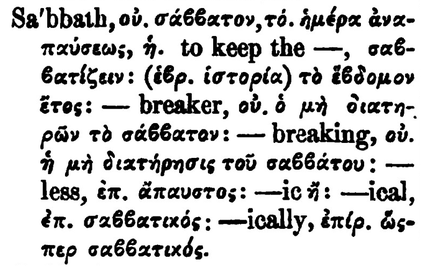
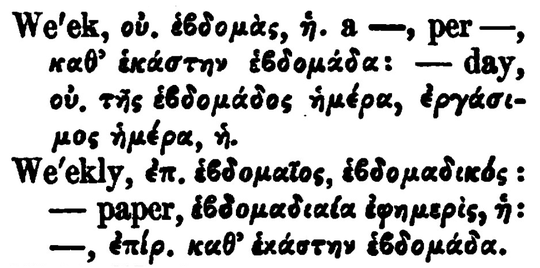
No Greek has ever equated the Sabbath (σαββατου, σαββατων) with the week (εβδομάδα). Why? Because in ancient Greek, there have always been different words for both terms, which have completely different linguistic roots, namely rest (Hebrew loanword Sabbath) and sevenness (week, seven, number 7). Even today, there is not a single language in the world that equates the Sabbath with a 7-day week, because the Sabbath is included as the last day anyway. This absurd theory originated in the time of the Catholic Church Fathers, because they wanted Christians to break away from the biblical calendar and rest on pagan holidays. Therefore, it was claimed that the Lord Jesus Christ allegedly rose “on a Sunday” (the so-called “Christian Sabbath” or “Christian Saturday”), thereby giving special honor to this pagan day named in honor of the sun god (sun day). In this way, Christians were persuaded to rest on the same holidays as the pagans.
An important fact: As we have demonstrated on this website for every Bible verse (Mt 28:1; Mk 16:2; Mk 16:9; Lk 24:1, Jn 20:1; Jn 20:19), there are a flood of correctly translated Bibles from all over the world that will never accept the manipulations of the King James Bible (KJV). So we are by no means expressing our own opinion or spreading a new doctrine, but rather conveying ancient Christian basic knowledge that many before us already knew and that can be easily and quickly verified using the many correct Bible translations. So it is one statement against another. Who should we believe, the many other translators who report on the Sabbath, or King James and James Strong of the Methodist Church, who want to persuade us to accept Sunday?
For us, the answer is clear: the Bible interprets itself, God defines the words, and we have only two options. Either we accept it as it was given to us by God, or we twist it to support the teachings of the Catholic Church. There is no middle path.
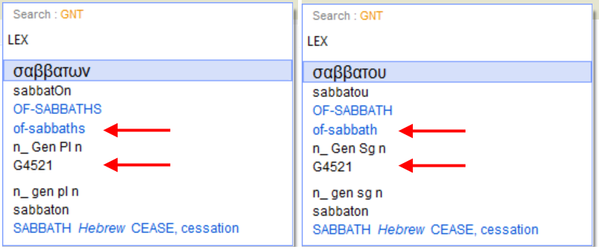
The free program ISA3 from Scripture4All also defines Strong number G4521 correctly. These Christians adhere only to the meaning of the word that God has given us and reject the modern interpretations of theologians.
Therefore, Strong's number G4521 (σαββατων, σαββατου) is correctly defined as Sabbaths (genitive plural) or Sabbath (genitive singular). A perfect work.
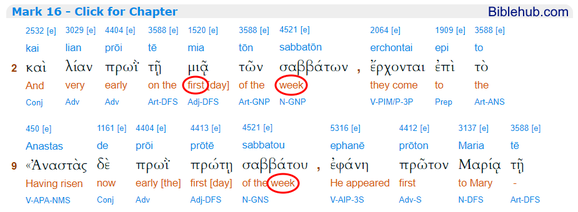
The following illustrations show a direct comparison between a substitution (Biblehub) and a translation (Scripture4All) in Mark 16:2 and Mark 16:9. As can be clearly seen, Biblehub not only had to replace the Sabbath with week, but also replace a cardinal number (one, mia) with an ordinal number (first, prote) and add the word “day” (ημερα, hemera) in square brackets to get the desired Sunday. These are three errors. The translation of both verses is extremely simple, as Scripture4All shows:
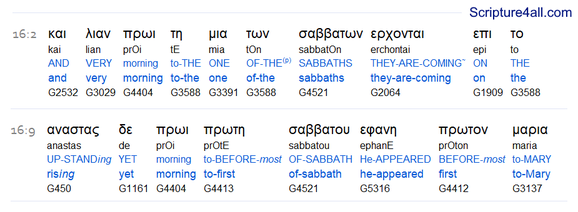
Viele Bibeln haben beide Verse richtig übersetzt, wie z.B. die Concordant Literal Version:
Mk 16:2 And, very early in the morning on one of the sabbaths, they are coming to the tomb at the rising of the sun.
Mk 16:9 Now, rising in the morning in the first sabbath, He appeared first to Mary Magdalene...
Anyone who disagrees with our explanations should simply show us how they themselves would translate the English phrases “on the one of the Sabbaths” (Mark 16:2; Luke 24:1; John 20:1) and “early on the first Sabbath” (Mark 16:9) into Ancient Greek. All discussions would then quickly come to an end, because everyone must use the same words that appear in the NT. And then when retranslated into English, this cannot suddenly mean “on the first day of the week,” “after the Sabbath,” or “on a Sunday.” It becomes clear how demonic all this is and how brutally the word of God is twisted by many Christians who reject all arguments because they want to see Sunday in the Bible with all their might.
Many pastors, for example, keep saying, “Sabbath (σαββατων, σαββατου) also means week, that's how it is.” No, that's not how it is. Sabbath (σαββατων, σαββατου) means Sabbath, week (εβδομάδα) means week, and Sunday (μέρα του ήλιου) means Sunday, in every language. That is how it is.
The authors of the KJV, James Strong, Biblehub, and other theologians are unaware of how much they are sinning against God by depriving God of the opportunity to speak about the Sabbath in ancient Greek. No matter what God says, they twist everything to emphasize the desired Sunday. What good are religious practices to them if they want to lead the bride of Christ away from the old calendar and feast days of the Bible and toward the new calendars and feasts of the pope?
We write this as a warning because we ourselves were misled for many years and, unfortunately, preached a different Sunday gospel (Gal 1:8-9) to other Christians that cannot be found in the Bible, misinterpreting the words of our Lord Jesus Christ. But then we repented and now belong to the few who want to shake up lukewarm Christianity and lead it back to the original teachings of the Bible and the early church. We do not judge others, but we warn them. What you do with this information is your responsibility; in any case, our conscience is now free.
God cannot speak of the Sabbath in any language
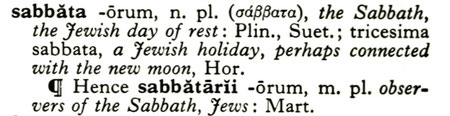
Latin dictionaries describe that the foreign word sabbata (sabbatorum), which originates from Hebrew, refers to the Sabbath (or Saturday), as there are two separate terms for the Latin week, namely hebdomada and septimana, both of which mean sevenness (a unit of seven).
See Latin Bibles.
Nevertheless, theologians also say here that the Latin word “sabbati,” which is mentioned in the resurrection chapter of the Vulgate, allegedly also refers to the week or Sunday (dies solis), because it would be the so-called “Christian Sabbath,” i.e., Sunday (dies solis). In addition, “una” (one) is redefined as ‘prima’ (first) and the word “day” (dies, die) is placed before the Sabbath (sabbati), which suddenly also means a week (hebdomada, septimana). Thus, the very easy-to-translate “una sabbati” (= on a Sabbath, in the singular genitive) suddenly becomes “on the first day of the week” (in primo die hebdomadis). The same three errors (which are actually substitutions) made in the ancient Greek text now also appear in the Bibles translated from the Vulgate.
We hear the same crazy argument from German theologians, because many German Bibles (manuscripts and prints, including the Luther Bible) were translated accurately from the Vulgate and the Greek Textus Receptus and report that the women came to the tomb “on a Sabbath” or even “on a Saturday” morning. Here, too, theologians have the same crazy excuse and want to convince us that this supposedly refers to the “Christian Saturday,” which is actually supposed to be Sunday. No, there is no such thing as a “Christian Saturday” as Sunday. Sabbath is Sabbath, Saturday is Saturday, Sunday is Sunday, and week is week. This is the case in all languages and dialects.
Specifically, this means that God, regardless of the language in which we read the Bible, can never speak of “a Sabbath” when referring to the day of the resurrection of the Lord Jesus Christ, since this Sabbath is always meant to mean “a Sunday.” Even when they find the word “Sabbath” in the Bible, they say:
“Yes, the Sabbath is mentioned in the Bible, but it refers to the Christian Sabbath, that is, Sunday, the first day of the week.”
Isn't that a demonic argument? With these wild definitions, they pass their own judgment before God, for they have seduced God's children.
5. Strong's numbers for the words eternity, grave, Hades, soul, hell...
The KJV has 42 English terms for the biblical word “soul” alone, which leads to great confusion. Readers of the King James Bible will therefore never learn what the soul actually is, what state the dead are in, and what hell and the grave are. And when Christians use the definitions of Strong's numbers without checking them, even though they are inaccurate or even wrong, great harm is done. An example on the subject of Hades:

Quote from James Strong with his definition of Strong number 86, hadés:
“From a (as negative particle) and 1492 [eido]; properly, unseen, i.e. "Hades" or the place (state) of departed souls: -- grave, hell.”
Here too, James Strong correctly defines how the Bible defines certain Greek words, but after the sign “: --” he shows how the King James Bible translates them. He does not point out the obvious error, but makes it look as if it were another translation option. This deprives all readers of the KJV of the opportunity to learn what Hades actually is. In the Bible, it is the place where the dead rest (sleep), divided into several chambers.
The equivalent in the Old Testament is Sheol. Jonah was “three days and three nights in Sheol” (Jonah 1:17; 2:2; “out of the belly of Sheol I cried”), and in Acts 2:27, Psalm 16:10 (Sheol) is quoted and prophetically applied to Jesus: “For you will not abandon my soul to Sheol, or let your holy one see corruption”. The ESV translates Acts 2:27 as follows: “For you will not abandon [leave] my soul to Hades, or let your Holy One see corruption.” Jesus was not in hell for “three days and three nights,” but in Hades, the ancient Greek term for the place where the dead reside, where they sleep and wait for the day of resurrection. Jonah, Job, and Jesus were in Sheol/Hades, but not in hell, for there is a completely different word for that in ancient Greek, which even appears in the Bible, namely Gehnenna (1067). Biblehub (HELPS Word-studies) accurately explains under Strong's No. 86 what Hades means, namely:
“hádēs (from 1 /A "not" and idein/eidō, "see") – properly, the "unseen place," referring to the (invisible) realm in which all the dead reside, i.e. the present dwelling place of all the departed (deceased); Hades.”
As in this case, Biblehub should also have pointed out in the four points mentioned above that the authors of the KJV and James Strong defined some Greek words incorrectly. There are sufficient sources to confirm this.
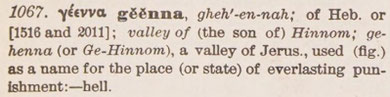
Quote from James Strong with his definition of Strong number 1067, geenna:
“gehenna, hell. Of Hebrew origin (gay' and Hinnom); valley of (the son of) Hinnom; ge-henna (or Ge-Hinnom), a valley of Jerusalem, used (figuratively) as a name for the place (or state) of everlasting punishment: -- hell.”
If Strong's number 1067 (gehenna) means “hell,” then Strong's number 86 (hades) cannot also mean “hell.” James Strong confuses Christians on this point as well, solely to directly and indirectly support the many false teachings in the KJV.
See the chapter: The KJV was not inspired by God.
6. Further errors in the creation of Strong's numbers
We have already pointed out that the definition of the Strong number was the personal decision of a man (James Strong) who belonged to the Methodist Church and referred to the text of the King James Bible. If a Catholic had created and defined the Strong numbers, he would have come to a similar conclusion, since his goal is to defend Catholic teachings on Easter Sunday. The Catholic Church Fathers used similar arguments in the early centuries because no one else would accept and observe Sunday as a holiday. However, if experts created Strong numbers correctly and independently of churches, the results would be very different, and Passover would never become Easter, the Sabbath would never become a week or Sunday, and Hades would never become hell. We could continue the list of errors, but that would make this website too long. Therefore, we will only point out a few important general errors:
- Very important, something many Christians don't know: The words listed at the end of a Strong's entry after the sign “:—” (or
“:--” in Biblehub) are NOT actual definitions of the Hebrew or Greek words. Instead, they are references to the KJV, showing how the word was translated in the KJV. Example: Strong's
number 3957 (pascha) reads “:— Easter, Passover (:-- Easter, Passover)” and Strong's number 4521 (sabbaton) reads “:— Sabbath
(day), week (:-- sabbath (day), week)”. This means that this is how it was translated in the KJV, but it is not a definition of the word. Once again, to be clear: these are not definitions
of the words, but merely information about how they were translated in the King James Version. Many pastors are unaware of this and therefore misinterpret the Strong numbers, causing great harm
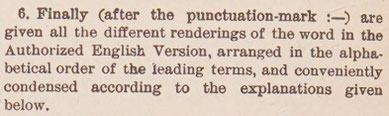
to their churches. They only look at a Strong number, but have not read the explanations in the preface, because point 6 (see screenshot above at point 4, Sabbaton) states:
“Finally (after the punctuation-mark :—) are given all the different renderings of the word in the Authorized English Version, arranged in the alphabetical order of the feading terms, and conveniently condensed according to the explanations given below.” - The dictionary (lexicon) associated with Strong's Concordance is outdated, and its definitions are considered “not particularly reliable” or “outdated and not particularly accurate” by modern standards. Nevertheless, new editions are repeatedly reprinted without significantly improving the content.
- Some Strong numbers are empty. For example, the Greek number 3281 has an empty entry that has remained in the numbering system created by James Strong. This also applies to numbers in the range 3203–3302. The index is based on the Textus Receptus, which forms the basis of the King James Version. When later editors discovered that a supposed word was either a duplicate spelling, a marginal note, or a manuscript error, the word was removed but its number was retained in order to maintain the page number concordance. Therefore, 3281 has no Greek lemma, no translation data, and no occurrences in the New Testament.
- There is no uniformity, because it often comes down to how a word was translated in the King James Version. This can be misleading, because context is very important. As many experts confirm, the authors of the KJV translated the ancient Greek text in a somewhat “careless” manner. This resulted in a multitude of English words for the same original word, and one cannot assume that any of these words is the true meaning of the original Greek word. There are 42 different English terms for the word “soul,” so a reader of the KJV can never know what God means by a soul and how He defines it. This error makes serious theological misinterpretations (e.g., “immortal soul”) inevitable.
- A major problem is the poor or missing grammar in Strong's Exhaustive Concordance of the Bible: Strong's numbers are only assigned to root words, not to different forms of those words (like “blessed” vs. “blessing”). The numbers do not reflect grammatical information such as person, gender, number, tense, voice, or mood. There are much better programs and systems (e.g., Scripture4All) that specify the grammar of each word exactly and are much better suited for genuine Bible study. Strong's numbers only allow for superficial and inaccurate work.
- The Strong numbers are based on the Textus Receptus, which formed the basis for the King James Version, and may not reflect the best available ancient manuscripts. Over the years, the majority text has emerged, which is significantly more accurate. Consequently, compromises must be made in Bibles that translate from the more accurate Textus Receptus editions, the Majority Text, and the Nestle/Aland Text.
- The ancient Greek language has many other words that are not mentioned in the Strong numbers but are part of the Septuagint (LXX) and important ancient literature
(e.g., the writings of Flavius Josephus, who lived in the same geographical area and at the same time as the evangelists). James Strong referred only to the limited text of the King James Bible.
This is a big mistake, because the Septuagint shows how the Jews themselves translated the Hebrew Old Testament and what the individual words actually mean (e.g., the Greek word for
week, εβδομάδα, or the plural of Sabbath, σαββατων). Without this basic knowledge, errors in the
translation of the ancient Greek New Testament are inevitable. They are the result of a lack of knowledge of the ancient Greek language and Hebrew traditions.
This is precisely the problem, because some theologians see that there is no corresponding word for week (εβδομάδα) in the Greek Strong numbers, and therefore spread the terrible heresy that the evangelists allegedly had to speak of “Sabbath” (singular) or “Sabbaths” (plural) when they meant a week (εβδομάδα). They see that the week appears only in Hebrew, but not in the ancient Greek Bible writings and Strong's numbers, and therefore think that the Greeks did not know what a week was and had to describe it with Hebrew Sabbaths. It is unbelievable to hear such nonsense in sermons, because both in the Septuagint and in the books of Josephus Flavius, one finds this word εβδομάδα (week). If God had meant the week (εβδομάδα), He would have expressed this through the four evangelists. But God meant the Sabbath seven times, which is why the week is not part of the ancient Greek New Testament. God did not make a mistake, but theologians make a big mistake when they steal God's words from the Bible and replace them with others.
Revising the Strong numbers is therefore not helpful; instead, a completely new numbering system must be created that contains more words, is more precisely defined, and also takes grammar into account. Better solutions already exist (such as Scripture4All), but they are not used by most Christians because they do not like the literal statements in the Bible, as this would mean finally abandoning their Sunday theory, which would lead to a division in the church and cost some pastors their jobs. Most Christians want to take the lukewarm, comfortable path and not stand up for the correct translation of the New Testament. - The Strong numbers and the accompanying lexicon are only a tool, not divinely inspired writings. They reflect the opinions of the authors of the KJV, James Strong, and some colleagues from the Methodist and Anglican churches. The information should never be used to “overrule” the expertise and decisions of experienced linguists. The Strong numbers serve merely as a basis for discussion, to better classify and find words using numbers, but the word definitions they contain are often inaccurate or even incorrect.
- The use of Strong's numbers is NEVER a substitute for an in-depth study of the original biblical languages, as they do not take syntax, grammar, or context into account. Scripture4All is much better suited for a true word study, as it not only defines the words correctly, but also indicates the exact grammatical forms.
- Some words in the KJV (e.g., “deliver”) are linked to a specific Strong's number, but the meaning of the word in that particular verse may differ from its general definition.
- As already mentioned, it must be emphasized again and again: The Strong system is inaccurate and outdated. Bible study software and newer, more accurate concordances offer better opportunities to access and understand the original languages.
-
No facts, only opinions: Strong's numbers do not convey facts about how a particular biblical word is defined by God, but rather describe how that word is understood or
interpreted according to the teachings of the Methodist, Anglican, and Catholic churches. So when some Christians say that it is a so-called “fact” that Passover, according
to Strong's numbers, also means Easter, that Hades means hell, and
that the Sabbath also means the week or Sunday, then it is only a
fact that some theologians define it that way. But that does not mean that it is a fact as God defines it. If pastors do not even know that the text after the symbol “: --” does not indicate a word definition, but only the translation variants of the KJV, then these pastors show how poorly informed they are and how they are
misleading the church. Instead, the fact is that God does NOT define it that way, because otherwise He would have chosen completely different ancient Greek words, which would then be included
in the New Testament.
A comparison with the definition of the Hebrew words “Passover,” ‘Sheol’ (hades), “Sabbath,” and “week” clearly shows that the Hebrews would never accept today's Christian view, which gives new Christian interpretations and definitions to the old, clearly defined Hebrew words. Neither Jesus nor the early Christian church would ever accept this. This is a fact, because these new Christian views would replace the Word of God. You can try to impose these new Christian supposed “facts” on the people of Israel, and you will see that they are rejected everywhere, except perhaps by some “Messianic Christians” who have adopted the traditions and holidays of the Pope, which are not mentioned anywhere in the entire Bible. Instead, the fact is that God does NOT define it that way, because otherwise He would have chosen completely different ancient Greek words, which would then be included in the New Testament.
Conclusion on Strong's numbers
As has been shown, the authors of the KJV, James Strong, and the theologians who followed them made some serious mistakes by giving new meanings to previously clearly defined words in order to transform the biblical Sabbath into a pagan Sunday and the biblical Passover according to God's calendar into a non-biblical Easter according to the Pope's calendar.
The Word of God is the most precious thing we have here on earth, so every word must be translated as God has given it to us. No word may be taken away, no word may be added, and no word may be redefined. Otherwise, this is not only a violation of Christianity, but also a sin before God, who watches over His Word and sees what pastors and theologians do with it. There is only one true gospel, not two.
Ignorance and cowardice do not protect you from consequences before God
Most theologians and pastors do not think independently, but adopt much of what is prescribed to them by their church leadership. It is similar to the military. If they had lived at the time of Jesus, most of them would certainly have blindly followed the scribes and Pharisees and instead criticized Jesus for his allegedly unloving manner in which he attacked these priests. They do not see that Jesus was in favor of pure biblical teaching and against modern interpretations. Most pastors are too ignorant and too cowardly to point out and correct errors in doctrine because they fear for their jobs and put their own safety above the Word of God. Jesus and Paul constantly had disputes in the church because they were not fair-weather Christians, but pointed out abuses and false teachings in order to protect the flock (the church). Many pastors also do not want to learn because doing so could put them at risk of discovering errors in their church, which would have practical negative consequences for them personally, even to the point of being expelled from their own church. Ignorance does not protect them, because they are responsible for themselves.
In conversations, we repeatedly find that pastors agree with us, but then say that they cannot say this in church because otherwise no one would come anymore. Instead, they teach their congregants what Christians want to hear, thereby betraying their following of the Lord Jesus Christ.
It is not the Spirit of God who reinterprets words that have been clearly defined by God since creation. We repeatedly receive emails from Christians thanking us for revealing the truth, but then they repeatedly write that they are not allowed to say this in their churches because they are afraid of being excluded and losing fellowship with other Christians. This is reminiscent of the parents of the man born blind:
John 9:20-23: “His parents answered, “We know that this is our son and that he was born blind. 21 But how he now sees we do not know, nor do we know who opened his eyes. Ask him; he is of age. He will speak for himself.” 22 (His parents said these things because they feared the Jews, for the Jews had already agreed that if anyone should confess Jesus to be Christ, he was to be put out of the synagogue.) 23 Therefore his parents said, “He is of age; ask him.”
We live in similar times, in which some distort the teachings of the Messiah by twisting the sign of the Messiah (3 days and 3 nights) into a sign of the Pope (1.5 days), transforming the Sabbath into Sunday and Passover into a beautiful Easter celebration; but most remain silent. Anyone who criticizes this is expelled from the church because these pastors cannot refute anything, but do not want unrest and divisions in the church. In this way, they suppress the truth of Jesus Christ and cover it up with a spiritual blanket. In doing so, they write their own judgment. We will all soon stand before God, and it is better if we have not changed His biblical word:
1Thess 5:21-22 (KJV): ”Prove all things; hold fast that which is good. Abstain from all appearance of evil“
Eph 5:11 (ESV): ”Take no part in the unfruitful works of darkness, but instead expose them“
THE ERRORS ON Biblehub.com
The last passage highlights some errors in the interlinear text from Biblehub. Below that, the correct translation from Scripture4All is shown for comparison. Now you can decide for yourself which text you want to believe. Please note that there are many Bibles (including the Vulgate and the original Luther Bible) that have been translated correctly:
Matthew 28:1 on Biblehub and Scripture4All


As can be clearly seen, Biblehub does not provide a translation, but rather a substitution. The word sabbaton (σαββατων) used in Matthew 28:1a is exactly the same as in Matthew 28:1b. The word, which is 100% identical and clearly defined as “Sabbath” according to Strong's number 4521, cannot mean ‘Sabbaths’ in the plural and “week” in the singular in the same sentence. This is a falsification and manipulation of the Word of God. Furthermore, God (not us) gave us mian 1520 (or 3391), a cardinal number that means “one” but not the ordinal number “first” (Strong's number 4413, see Mk 16:9 below).
One question: How would God have had to express it in ancient Greek if he really meant “one of the Sabbaths” instead of “on the first day of the week”? Answer: There is only one possibility, namely “mian sabbaton.” And that is exactly what it says in the Bible. Biblehub has no right to place itself above God and convert “a/one Sabbath/s” into “the first day of the week” (πρωτη ημερα της εβδομαδας) and thus spread a different gospel. If God had meant the week (εβδομαδα) or Sunday (ημερα του ηλίου), He would have said so in ancient Greek, for which he had over 24 possibilities in ancient Greek. See the following chapters for more on this:
- no Sunday
- “on one” was replaced by “on the first”
- Definition of Sabbath and week
Mark 16:2 on Biblehub and Scripture4All


Biblehub makes several major mistakes in Mark 16,2. As can be clearly seen, Strong number 1520/3391 (one, mia) has been reinterpreted as Strong number 4413 (first, prote). In addition, Strong's number 4521 (Sabbath) has been changed to a week. There is no Strong's number for this, although the ancient Greek word for week (εβδομαδα, ebdomada) occurs frequently in the Septuagint (LXX) and in the writings of Josephus Flavius, who lived at the same time and in the same area as the evangelists. The expression “μια των σαββατων” cannot have 35 different meanings and two different days of resurrection (see examples), but only one day of the week. This day of the week was named seven (7) times by God with the name “Sabbath” (σαββατου, σαββατων), which has been clearly defined since creation. Other words (week, Sunday) must not be added to the Bible, and the Sabbath must not be stolen from the Bible.
Very important: As can be clearly seen, Biblehub adds, after the feminine word “mia” (meaning a/one, but not first), the feminine word “day” (Greek: hemera) in square brackets [ ] without being aware of its meaning. The result is nothing other than the expression “on the one day of the Sabbaths” (την μια ημέρα των σαβάτων). Both the ancient Greek translation of the Hebrew test (the Septuagint) and the New Testament itself define the “day of the Sabbaths” in the plural as “Sabbath day” in the singular, in accordance with the rules of ancient Greek grammar. So it is not about the “first day of the week” (την πρώτη ημέρα της εβδομάδας), but about “on a/one day of the Sabbaths” (την μια ημέρα των σαβάτων). This is very easy to translate; it is about “a Sabbath day.”
See the chapters:
- one not first
- μια των σαββατων
- the day of the Sabbaths
- the plural sabbaton
- Definition of Sabbath and week
- Mk 16,2; Lk 24,1; Joh 20,1; Acts 20:7
Mark 16:9 on Biblehub and Scripture4All


In Mark 16:9, Biblehub cannot be a misunderstanding in translation. Here, a clear falsification and manipulation of the Word of God in the KJV and Strong's numbers is revealed. As you can see, the word “Sabbath” (4521, σαββατου) in the singular is translated as “week” (i.e., as 7 days). In addition, the word “day” (ημερα, hemera) is added to the Bible, as indicated by the square brackets [ ].
Since some theologians claim that the plural form of Sabbath (σαββατων, sabbaton) could also mean week (εβδομαδα, ebdomada), this wild theory is clearly refuted in Mark 16:9 at the latest, because here we are dealing with the Sabbath (σαββατου) in the singular genitive form, which is extremely easy to translate.
So that Christians would not be misled and could trust the Bible, God mentioned the Sabbath seven (7) times in the resurrection chapters, not only in the plural (σαββατων), but also in the singular (σαββατου). Throughout Greek literature, this always means the Sabbath, except on the very day of Jesus Christ's resurrection, when it suddenly means week or Sunday? And we are supposed to believe that? No, there is no such exception; it is a pure invention of some Sunday theologians.
We are in contact with the highest church leaders of several churches worldwide. And every time we ask, “How would you express it in ancient Greek if you wanted to say ‘early on the first Sabbath’ in the singular genitive form in ancient Greek?”, not a single theologian has answered us in 17 years. Why? Simply because they would have to use the 100% exact words that are also found in the New Testament in Mark 16:9. Instead, pastors often become aggressive and say:
“God couldn't have meant the Sabbath, because that's the Jewish holiday, but we are Christians and our holiday is Sunday, and you don't have to take everything in the Bible literally.”
Wrong, all theologians should know: They have no right to steal the words chosen by God from the Bible and replace them with others.
Why can't a single theologian or pastor translate “early on the first Sabbath” (singular genitive) from English into Ancient Greek? It's so simple. The truth is: they can, but they don't want to, because they would have to use exactly the same words that appear in Mark 16:9, namely “proi prote sabbatou” (πρωι πρωτη σαββατου). This fills them with fear and dread, because they know exactly what comes next, namely the uncomfortable question:
“And why should this suddenly mean ‘after the Sabbath,’ ‘on the first day of the week,’ and ‘on a Sunday’ in a new translation into English?”
You see, theologians and pastors take away God's opportunity to speak of the “first Sabbath” (Mark 16:9) because they want Sunday with all their might. In doing so, they condemn themselves because they publicly show how little they truly love God's Word and Jesus Christ. They know nothing about God's calendar and the seven Sabbaths until Pentecost, which are explained in Leviticus 23. They are religious and want to avoid problems and have a comfortable Sunday service. To this end, they make several compromises with the Word of God. The “sign of the Messiah” (3 days and 3 nights) must then be twisted into a turbo resurrection after only 1.5 days for their Sunday theory. So many falsifications are necessary only if the translation is wrong from the beginning.
And if you insist so much on distancing yourself from the Jews, you should know that we received the Old Testament (66% of the Bible) from the Hebrews and that our Lord Jesus Christ came from this people. Without the Old Testament, you will never be able to understand the New Testament. You degrade the Sabbath to a day of preparation (preparation day and work day) for your desired pagan holiday (Sunday). And you call all this “Christian”?
Luke 24:1 on Biblehub and Scripture4All


See commentary on Mk 16:2 and mia ton sabbaton.
John 20:1 on Biblehub and Scripture4All


See commentary on Mk 16:2 and mia ton sabbaton.
John 20:19 on Biblehub and Scripture4All


See commentary on Mk 16:2 and mia ton sabbaton.
Acts 20:7 on Biblehub and Scripture4All


See commentary on Mk 16:2 and mia ton sabbaton.
1 Cor 16:2 on Biblehub and Scripture4All


See commentary on Mk 16:2 and mia ton sabbaton.
Luke 18:12 on Biblehub and Scripture4All


Biblehub defines incorrectly. The Sabbath in the singular genitive must not be exchanged for a 7-day week. The Pharisee fasted twice on the Sabbath, here is the evidence: Luke 18:12
The correct translations at Biblehub.com
Biblehub has not done everything wrong; most of it is correct. But the day of the week of Jesus' resurrection has been replaced rather than translated. It is interesting to see how Mark 16:1 has been translated, as well as the verses that refer to the “day of the Sabbaths” in the plural, namely Luke 4:16, Acts 13:14, and Acts 16:13.




What is a “day of the Sabbaths”?
In Mark 16:2, Luke 24:1, John 20:1, and Acts 20:7, we find the phrase “τη μια των σαββατων” (on the one of the Sabbaths). Many theologians say that after the feminine word mia (μια, one), the ancient Greek feminine word for “day” (ημερα, hemera) can be added, because although it was often not written out, it was implied. They say that although the Sabbath is also a day, strictly speaking it is neuter, which is why mia would refer to the day. This is not a problem, because it results in nothing other than:
τη μια [ημερα] των σαββατων = on the one [day] of the Sabbaths
Biblehub has correctly translated the “day of the Sabbaths” (ημερα των σαββατων) in Luke 4:16, Acts 13:14, and Acts 16:13. Almost all Bibles around the world refer to the “Sabbath day” in the singular in these passages. So the phrase “on a [day] of the Sabbaths” means nothing more than:
“on a Sabbath day”
It is quite simple, because the Hebrew expression for “on the day the Sabbath” or “on the Sabbath day” (Yom ha-Shabbat) in the singular genitive was translated in the Septuagint, in accordance with the special rules of Ancient Greek, into the plural genitive as “on the day of the Sabbaths” (ημερα των σαββατων). An ancient Greek expression “on a day of the Sabbaths” therefore means nothing other than “on a Sabbath day.” God never spoke of a week or a Sunday in the New Testament. See the detailed chapters on this subject:
- “Day of the Sabbaths” was replaced by “Day of the Sun”
- μια των σαββατων
- The plural σαββατων (Sabbaths) was reinterpreted
- “one not first”
”Prove all things; hold fast that which is good. Abstain from all appearance of evil“
(1Thess 5:21-22; KJV)
”Take no part in the unfruitful works of darkness, but instead expose them“
(Eph 5:11, ESV)